Research
The
group of Metal-Organic Frameworks led
by Dr. Francesc X. Llabrés i Xamena, specializes in the study of crystalline
porous materials, Metal-Organic Frameworks (MOFs), Covalent Organic compounds
and Porous Organic Capsules, and their use in various technological
applications, including heterogeneous catalysis. Within this context, our holistic
approach is focused on three main topics:
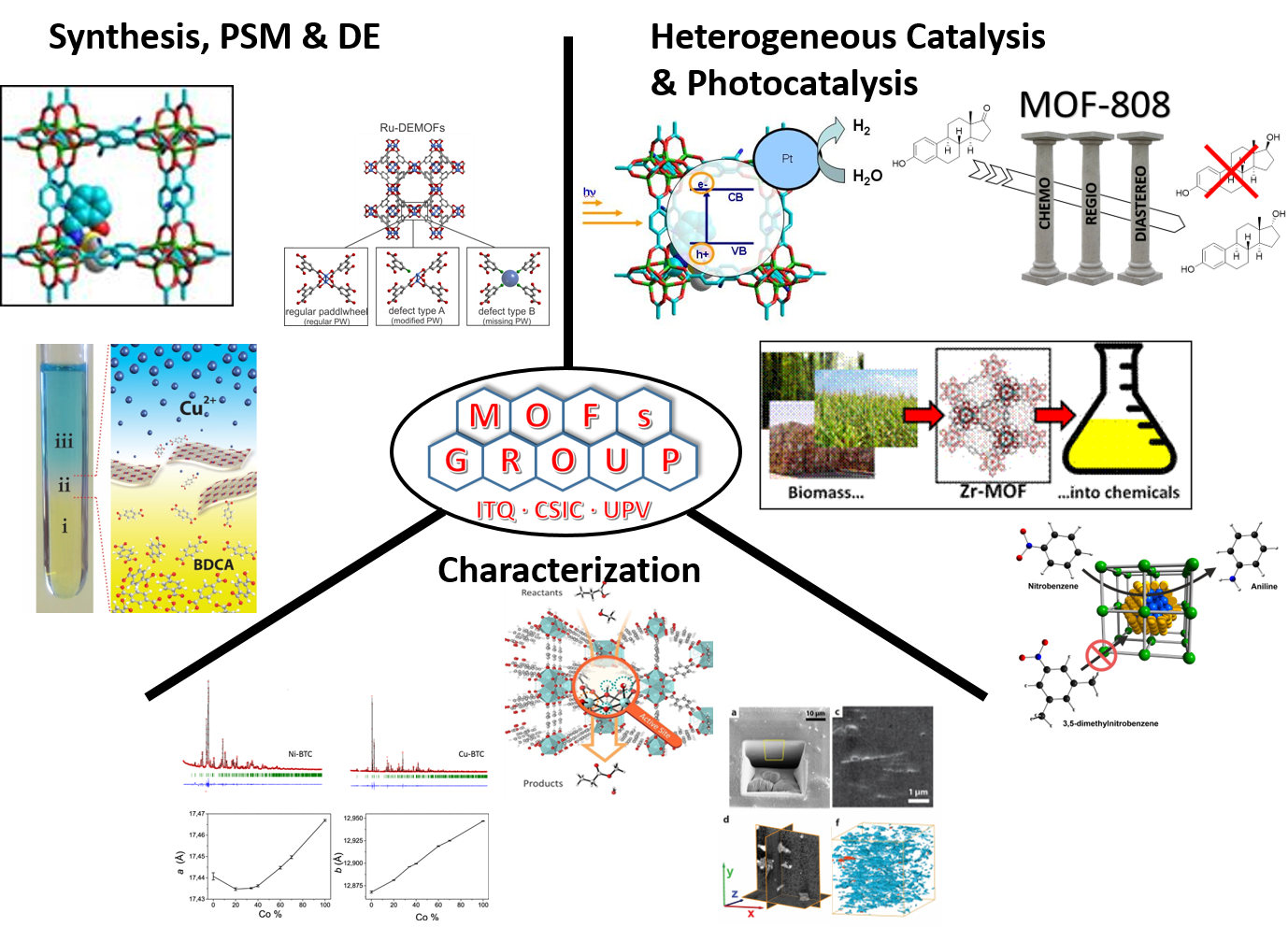
Synthesis, post-synthesis modification & defect engineering
The modular construction of MOFs provides an outstanding platform for designing a
vast number of novel high-performance functional materials. It allows
us fine-tuning the chemical composition, properties and pore architecture
by smart selection of the metal and organic ligands forming the MOF and
by controlling the way in which these sub-units are connected. However,
sometimes it is very challenging to introduce the desired
functionalities in a MOF by direct synthesis. In these cases,
post-synthesis modification (PSM) come into play. We have developed
various PSM strategies, mainly focused at introducing atomically
precise catalytic sites on pre-formed MOFs. Those include the formation
of salicylidene imine Schiff base metallic complexes or the use of
oxalate auxiliary linkers.
Recently, Defect engineering (DE), or the
deliberate creation of defects in MOFs, has emerged as a very effective
tool for tailoring material properties in sorption and catalysis. One
way of introducing defects during the synthesis of the MOF is by using
a “defective-linker approach", whereby the regular linker for the
synthesis of the MOF is mixed in appropriate amounts with a
geometrically equivalent second linker featuring a reduced
connectivity. This strategy has been successfully applied in our group
to the preparation of Ru, Cu and Zr-containing MOFs with tunable
catalytic properties.
Other relevant contributions from our group
to MOF synthesis are the preparation of mixed-metal and mixed-ligand
compounds with controlled spatial distribution within the crystalline
framework, the encapsulation of monometallic and bimetallic core-shell
metal nanoparticles, or the preparation of multi-functional MOFs
containing two or more chemical functionalities for cooperative or
multi-step catalytic transformations.
CharacterizationPrecise
understanding of the structural and physicochemical properties, as well
as the local (intracavity) environment of the active sites in MOFs, is
crucial to further develop their catalytic potential. Our goal is to
contribute to the characterization of MOFs beyond routinely used
laboratory techniques, by resorting to synchrotron based spectroscopies
(such as EXAFS/XANES) and ab initio x-ray and electron diffraction.
Collaborating with the group of Veronique Van Speybroeck (Ghent
University), computational tools have allowed us to understand how
these centers interact with the reaction substrates, thus assisting in
the proposal of sound reaction mechanisms. We have further used
advanced tomographic focused ion beam scanning electron microscopy
(FIB-SEM) combined with 3D image reconstruction for the quantification
of structural parameters of MOF-polymer composite membranes for gas
separations.
Heterogeneous CatalysisNo
doubt, our primary effort has been focused on the development of highly
efficient heterogeneous catalysts (and photocatalysts) based on MOFs.
We started our research in this area as early as 2006, when the number
of articles describing the use of MOFs in catalysis was still very
scarce. Thus, our works have pioneered the study of important aspects
in catalysis, such as catalyst stability and reusability,
shape-selectivity, or the preparation of multi-functional MOFs for
cooperative catalysis or multi-step cascade transformations. Throughout
these years, our goal has been to engineer at the molecular level the
active sites of a MOF and their chemical environment to maximize its
performance for a give reaction. Common targeted reactions have been
the synthesis of high added value fine chemical compounds and biomass derived products. These are
usually complex molecules, featuring several functionalities, requiring
highly chemo-, regio- and stereoselective catalysts for their
synthesis. Beyond the structure of the active site, control of the pore dimensions and connectivity of the MOF,
and the noncovalent host-guest interactions inside the pores, introduce
highly valuable shape/size-selective properties to drive the reaction
pathway through the desired outcome from various possible products.