
For the purpose of this study we counted up the number of times each student attended to class in each of the courses. Then, we divided this number by the number of sessions of the course along the year. We considered that students who attended to 20% or less sessions were students who did not regularly attend to class. Hence, we divided the sample of students into two groups: those who regularly attend to class and those who do not attend regularly. If we analyze the marks of both groups, it makes clear that students who regularly attend to class get a mark 13.43% higher than the average, and those who do not attend regularly get a mark 26.17% lower than the average. Therefore, there is a difference of almost 41% between the marks gotten by those who attend to class and the marks of those who do not. To complement the study, we assigned to each student what we call a rank of attendance. The rank of attendance is calculated dividing the number of times a student attended to class by the number of total lectures. This is represented in a dispersion chart to show the influence of the rank of attendance on marks. Figure 1 shows this charts for theory lectures, laboratory lectures, and for theory and laboratory lectures together.
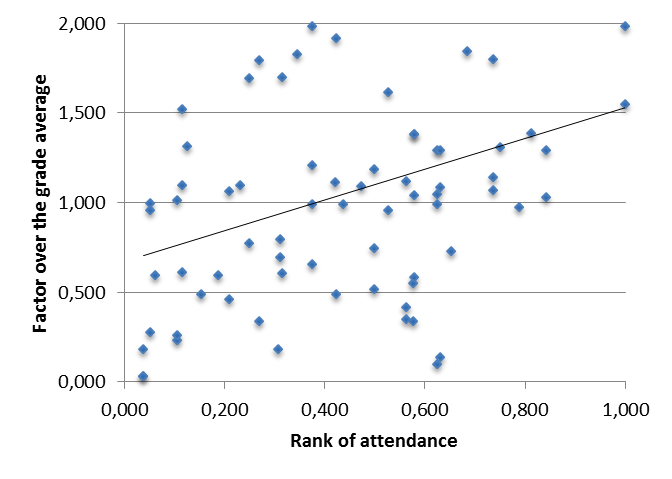
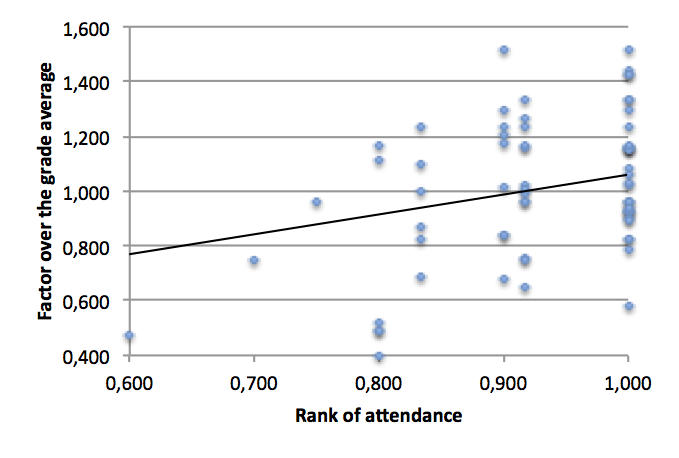
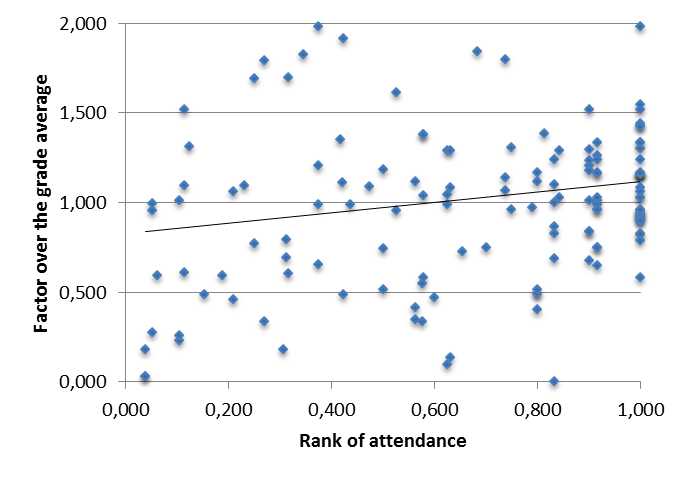
These charts reveal, and more important, quantify, what is commonly expected: marks are increased with the number of times students attend to class. In the case of theory lessons this difference is very clear, and it can reach almost 100% as it is demonstrated by the tendency line.
We also wanted to study the relation attendance-mark with a binomial regression (logistic regression), which produced Pr(> |z|) = 0, 0296. This result shows that there is a statistically proved influence of attendance on marks.