
First, a student who gives up the course should be understood as a (enrolled) student who finally does not take the final exam. To answer this question we counted the students who attended to class at least once, and that gave up the course without taking the final exam. From the general sample, considering all the courses and groups, it was extracted a sample of 33 students that fulfilled the previous conditions. For the analysis, we counted everyday the number of students in the sample that attended to class. This determined whether a similar number of attendances were registered all days, or if, contrarily, the distribution was not uniform and indicative of some tendency. A chart collecting all this information is shown in Figure 1.

This chart shows a decreasing tendency of the attendance until it reaches the absenteeism at the end of the year. This tendency clearly indicates the gradual withdrawal from the course as the year moves forward. As an indicator, teachers can expect an exodus from the first third of the year. In particular, from the 7th day of class on, the number of these students who attend to class notably decreases, and from the 16th day of class on, the attendance is practically nonexistent. Therefore, teachers should make an effort to motivate these students in the first third of the year and as soon as possible, because they gradually give up the course.
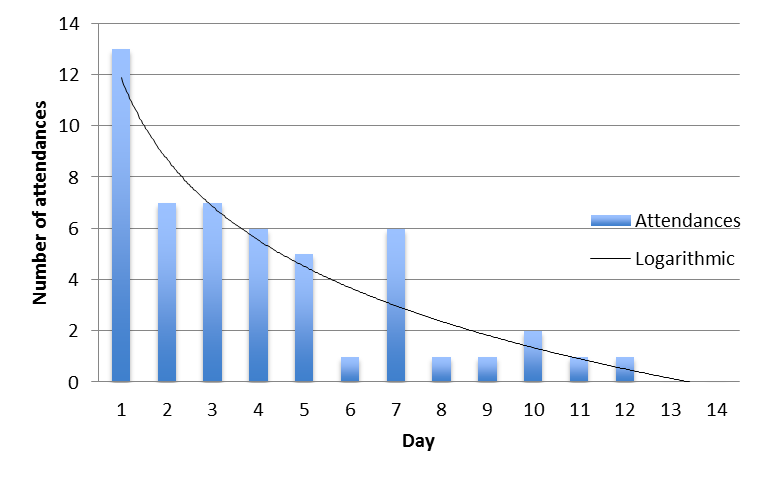
(a)
Attendances
in
four-month
courses |
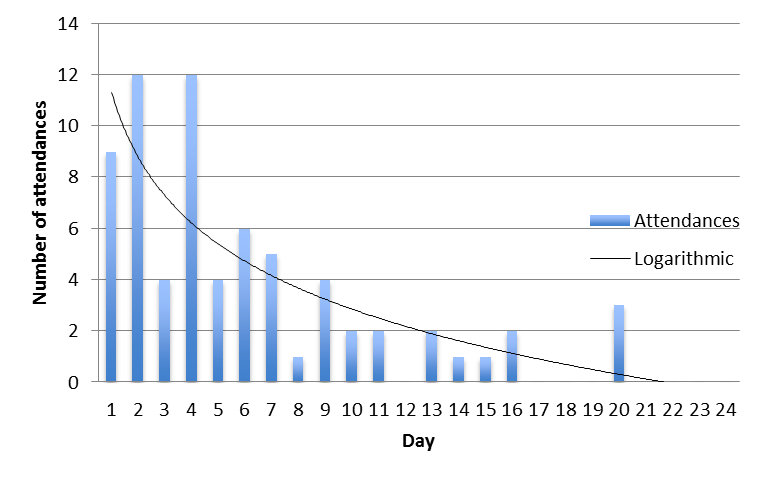
(b)
Attendances
in
annual
courses |
We mathematically approximated the formula that describes the attendances of students who give up the course. For a course of N sessions, the number of attendances of these students at session 1 ≤ n ≤ N is computed with the mathematical expression:

We validated this formula with a Pearson’s Chi-square test, which produced a p-value of 0,31. This shows that the distribution of data is logarithmic, and the formula is a sufficiently good approximation, indicating that it is a confident model to predict the attendances.
The study has been also carried out by splitting the data in four-month and annual courses (see Figure 2). This has been done to study whether having some courses that last twice than others has some influence on the student giving up. Results are very similar in both cases, while it is true that withdrawal appears a little later in the annual courses.